
Google Just Rewrote The Rules Of Search.
Here's What Every CPA Firm Needs To Know

Mike de Ravel
Mike is a Fractional CMO for CPA firms, as well as the Founder at MITCO Digital - a marketing agency exclusively for accountants and tax pros; since 2018.
On May 19, 2026, Google held its annual I/O developer conference and what came out of it was not a routine product update.
It was the most sweeping transformation of Google Search in 25 years.
If you run an accounting firm that relies on organic search, referrals, or any online presence to attract new clients, this one affects you directly.
MITCO Digital has spent more than 8 years building search strategies for accounting firms; with the past three years specifically focused on leading the way in AI search visibility.
That work involves structuring content to surface inside AI Overviews, optimising for citation by ChatGPT, Perplexity, and Gemini, and tracking the leads generated from AI-referred traffic. It has produced real, measurable results for our clients well before this week’s announcements.
Google I/O 2026 confirms our assumptions. The future is AI search. The way users search is about to drastically evolve. And the way accounting firms show up in those searches needs to adapt.
What follows is a plain-English breakdown of what changed, why it matters, and what it means for where your firm stands right now.
Prefer to listen to this instead? Join our hosts, Minnie Profit & Max Refund, as they discuss this topic.
What Google Actually Announced
1. Google Search Is Now "AI Search, Through And Through"
“Google Search isn’t just search with AI features. It is AI search, through and through.” — Liz Reid, Google’s Head of Search
That is not just AI jargon from the marketing department. The traditional model of Google search that you have known and loved for 25 years is going to look very different.
The days where you type a question (keyword) into the search bar, Google returns a ranked list of websites, and you click on one, is being retired.
In its place is a conversational AI system that synthesises answers, remembers context across a session, and increasingly handles the entire research journey without sending a user to a website at all.
The AI model powering all of this is called Gemini 3.5 Flash, which Google says runs 12 times faster than comparable frontier models. That speed is what makes the next announcement possible.
2. Background Search Agents
This is the announcement with the biggest practical implications for professional services firms.
Google introduced information agents: persistent AI agents that run 24/7 in the background, continuously monitoring the web on behalf of a user. You don’t need to search. You don’t need to ask again. You describe what you want once, and the agent finds it, synthesises it, and sends you an alert when something relevant surfaces.
Think of it as Google Alerts rebuilt from scratch with an AI layer on top. Instead of surfacing raw links, it delivers an intelligent summary and can take action on the user’s behalf.
Your website is no longer just competing for a ranking position. It is competing to be cited by an AI agent making a recommendation.
What this means in practice: a business owner looking for a CPA firm no longer types “best CPA firm near me” and scans a results page. They tell their Google agent: “Find me a CPA who specialises in small business taxes in [city], with strong reviews, and let me know when a good match comes up.” The agent handles the research, monitors continuously, and decides which firms to surface in its alert.
3. The Search Box Was Rebuilt From Scratch
For the first time in over 25 years, Google redesigned the search interface itself. This is really cool!
The new box expands dynamically to accept longer, conversational queries and takes in text, images, files, videos, and browser tabs as inputs. AI-powered suggestions now help users formulate their entire question, not just autocomplete the next word. Context carries forward across follow-up questions without losing the thread.
In practice, short keyword searches like “CPA firm Chicago” are giving way to full questions: “I run a 12-person professional services firm and I need a CPA who handles S-corp elections and quarterly estimates. Here’s a copy of my latest financials and a short video of me explaining what I need in more detail. Who can help me?”
Your content needs to be built to answer that kind of query. This is directly connected to how we approach content strategy for accounting firms, answering questions your ideal clients are actually asking rather than just pushing services you want to sell.
4. Gemini Spark
Gemini Spark is a 24/7 personal AI assistant that runs on cloud infrastructure, keeps working when your laptop is closed, and connects directly into your Gmail, Google Docs, and Calendar.
This is the tool your future clients will use to research CPA firms, compare proposals, and make hiring decisions. Spark synthesises information, cross-references it with data already in a person’s inbox or documents, and surfaces a recommendation. Firms that aren’t visible in the sources these agents draw from will simply not come up.
The Numbers Behind The Shift
These changes should be stirring up questions in your own mind about the quality of your current SEO approach.
This is not an issue to come back to in six months from now. It’s a challenge that firms need a strategy for, today.
The data from the first half of 2026 makes the trend clear already.
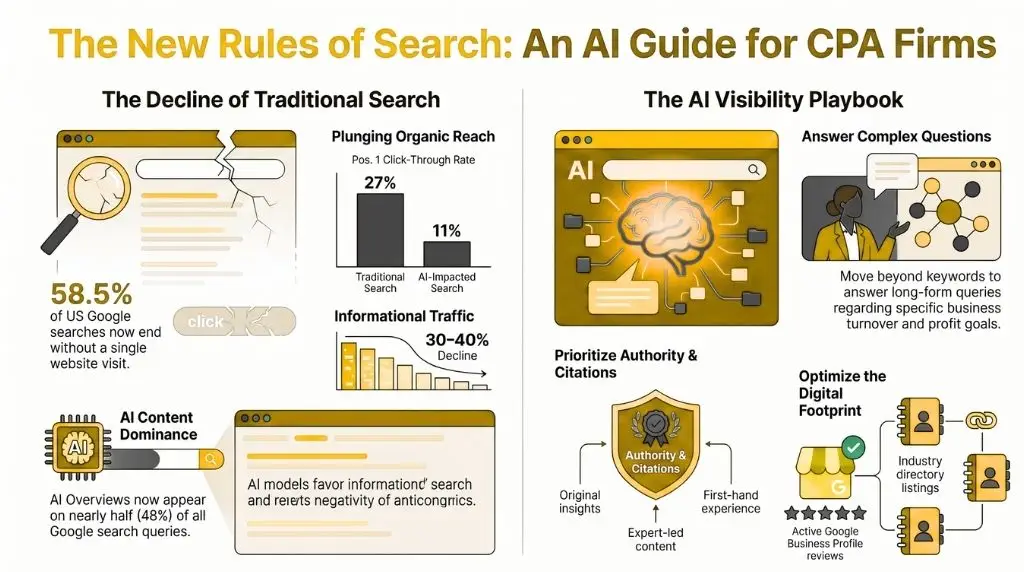
- Position 1 organic CTR has dropped from 27% to 11% (SISTRIX, March 2026) on queries where AI features appear. We’ve already seen this in our own data. Impressions (people seeing the website on the search results page) are up , but clicks through to the actual site are down.
- 58.5% of all US Google searches now end without a single website visit (SparkToro/Datos)
- AI Overviews now appear on 48% of all Google queries, up from 34.5% just three months prior (Ahrefs)
- Informational traffic categories have seen 30 to 40% traffic declines on affected queries
- Brands cited inside AI Overviews earn 35% more organic clicks than non-cited competitors ranking below the overview
That last point is worth focusing on.
Clicks are not dying equally across the board. They are concentrating on sources the AI names and cites.
This is why it’s critical that your accounting firm has a marketing agency that understands modern agentic SEO strategies and is able to rank your website in AI Overviews and search results, as well as on traditional search real estate.

Does your firm need a better marketing strategy?
Avoid wasting your time and money with strategies that don’t work.
We work exclusively with accounting firms. That means you get a team that knows what works, from day 1!
What This Means Specifically For CPA Firms
Is This A Completely New Playbook?
“How do we rank in AI? Do we need to change what we’re doing?”
This is the most common question we hear from firms paying attention to AEO (Answer Engine Optimization) and GEO (Generative Answer Optimization).
The honest answer is not entirely, but there is a real shift required.
Google made this explicit. A week before I/O, John Mueller from Google’s Search Relations team published an official guide titled “Optimising your website for generative AI features on Google Search”.
The central message from Google: there is no separate strategy for AI search. What the industry calls GEO and AEO are, in Google’s own words, “still SEO.” Strong content, clean technical structure, authoritative links, and consistent off-site presence are what earn citation inside an AI response. Its the same fundamentals, on a new surface.
While I agree with that, there are additional SEO tactics that need to be employed, or focused on, if you want to rank an accounting website in AI searches.
What has changed is the target. Traditional SEO aimed for top 3 position on a results page. The new target is citation inside an AI-generated answer. Those two surfaces don’t always match up. Research shows only around 14% of URLs cited in AI Mode overlap with what ranks in traditional organic results. A firm can hold strong rankings and still be effectively invisible inside AI surfaces.
Traditional rankings still matter and still drive a large volume of leads, particularly in the accounting industry. But the AI layer is increasingly where first impressions are formed, and the firms being cited there are pulling ahead of those that aren’t.
At MITCO Digital our AEO and GEO strategies are layered on top of our highly successful, traditional SEO strategies. With a strong foundation we’re able to add in AI-focused SEO tactics, that make it easy for these AI models to pick up our client’s websites.
The Game Is Now About Authority And Citation
Google’s AI draws on multiple signals to decide what to cite: the quality and depth of your content, how your firm appears across the broader web through reviews, media mentions, and directory listings, the technical structure of your site, and how well your content answers the specific questions real business owners are actually asking.
Think about the questions your best clients asked you before they hired you. Should my LLC be taxed as an S-corp? When does it make sense to hire a CPA rather than just use software and a bookkeeper? What do I need to have ready before my year-end tax appointment?
Those are the questions Google’s AI is now answering on behalf of business owners, and the firms whose content shows up in those answers are the firms that get the call.
We have written about why referral-dependent growth plateaus and what replaces it. The shift happening in search is a significant part of that story.
Background Agents Are The New Referral Engine
The referral has always been the gold standard for CPA firm growth. A trusted contact recommends you, the prospect calls with high intent and minimal resistance.
Google’s background agents work on a similar logic. When an agent has been monitoring the web on a business owner’s behalf and surfaces your firm in a synthesised recommendation, that is functionally a high-trust, low-friction introduction to a qualified prospect.
The difference is that agents don’t rely on personal relationships. They rely on data. Your online footprint, your website content, your reviews, your consistency across directories, your depth of published knowledge – that is what they evaluate and rank.
What To Do Now
1. Structure Content Around Questions, Not Just Keywords
This is the foundation of the content strategy we have been building out for accounting firms over the past three years. Every page needs to answer a specific question a business owner would actually ask. Within a page, we need depth of content to answer that question at every level.
Instead of targeting small keyphrases, think about what people are actually discussing with AI. Things like, “I have a manufacturing business that does $3M turnover. How do I grow it to $5M in 12 months and maintain the same profit %?”
The firms in our client base that are generating leads from AI-referred traffic consistently have content structured this way.
2. Build Content Only Your Firm Can Produce
AI models cite sources they consider authoritative and distinctive. Generic content like listicles and tax tip roundups gets synthesised and absorbed into the AI’s answer without attribution. What gets cited is original insight: your perspective on a recent ruling, your firm’s specific process, a real example of a problem you solved for a client. First-hand experience is the moat. Google’s own official guidance is unambiguous on this point: create valuable, non-commodity content. The more personal and expert-led you can make your content, the better.
3. Strengthen Your Digital Footprint Beyond Your Website
Google’s agents draw on a wide set of signals beyond your website. That means keeping your Google Business Profile current with active reviews, maintaining accurate listings on industry directories and your state CPA society, ensuring consistent name, address, and phone data across all platforms, and building genuine client reviews on Google and relevant platforms.
The Google Business Profile piece in particular is one that accounting firms frequently under-invest in. Agents read it.
4. Optimise For AI Surfaces Alongside Traditional Rankings
GEO is the practice of producing content that AI models, including Google, ChatGPT, Perplexity, and Gemini, will cite when answering questions your ideal clients are asking. It is an extension of the SEO fundamentals that have always worked, not a replacement for them, applied to a new set of surfaces.
We have been running this strategy for accounting firm clients that target both traditional search rankings and AI citation simultaneously. The lead volume from those clients is what convinced us to invest deeply in this approach well before this week’s announcements.
5. Update Your Measurement
Measuring marketing performance by organic traffic alone is increasingly unreliable. Impressions may hold steady while clicks fall, because users are getting answers without visiting your site. Metrics worth tracking now are branded search volume, inbound lead and enquiry volume, phone calls from organic channels, and AI-referred sessions, which are now trackable inside Google Analytics 4 via the native AI Assistant channel group.
The Bottom Line
Google I/O 2026 did not start this shift. It confirmed what has been in motion for a few years now and painted the roadmap to get there even faster.
The firms that will grow consistently over the next three to five years are no longer the ones with the most, or best ranking keywords. They are the ones that AI models consider the most authoritative and genuinely useful voice on accounting for (insert your audience here).
The approach that earns that authority is one that harnesses proven, traditional SEO methods, and layers in the new SEO tactics required to win the AI visibility battle. The work required to get this right requires real expertize at this level and the gap between firms that have invested in it and those that haven’t is becoming visible in actual lead data.
We have been building that foundation for accounting firms for over 8 years. If you want to understand where your firm stands against these changes, what’s working, what’s exposed, and what would move the needle, let’s have a chat.
Get Your AI Visibility Roadmap

MITCO Digital are first movers in ranking accounting websites in AI search results. We consistently generate leads for clients through platforms like ChatGPT, Claude, Gemini and AI summaries.
If your firm needs a modern SEO approach – speak to an agency that knows how to give you one.