

Your firm is solid. Clients are happy. Your team is good. Referrals have kept the pipeline moving for years.
But the growth has stalled. Some months are fine. Others are quiet. The referrals you used to rely on are less consistent, less predictable, and harder to control. And when you look online, smaller competitors are getting found by the exact small business owners and entrepreneurs you want to reach — while your firm barely registers.
You know you need a proper digital marketing system. You’ve just never found one that works for an accounting firm specifically.
That’s what this guide is for.
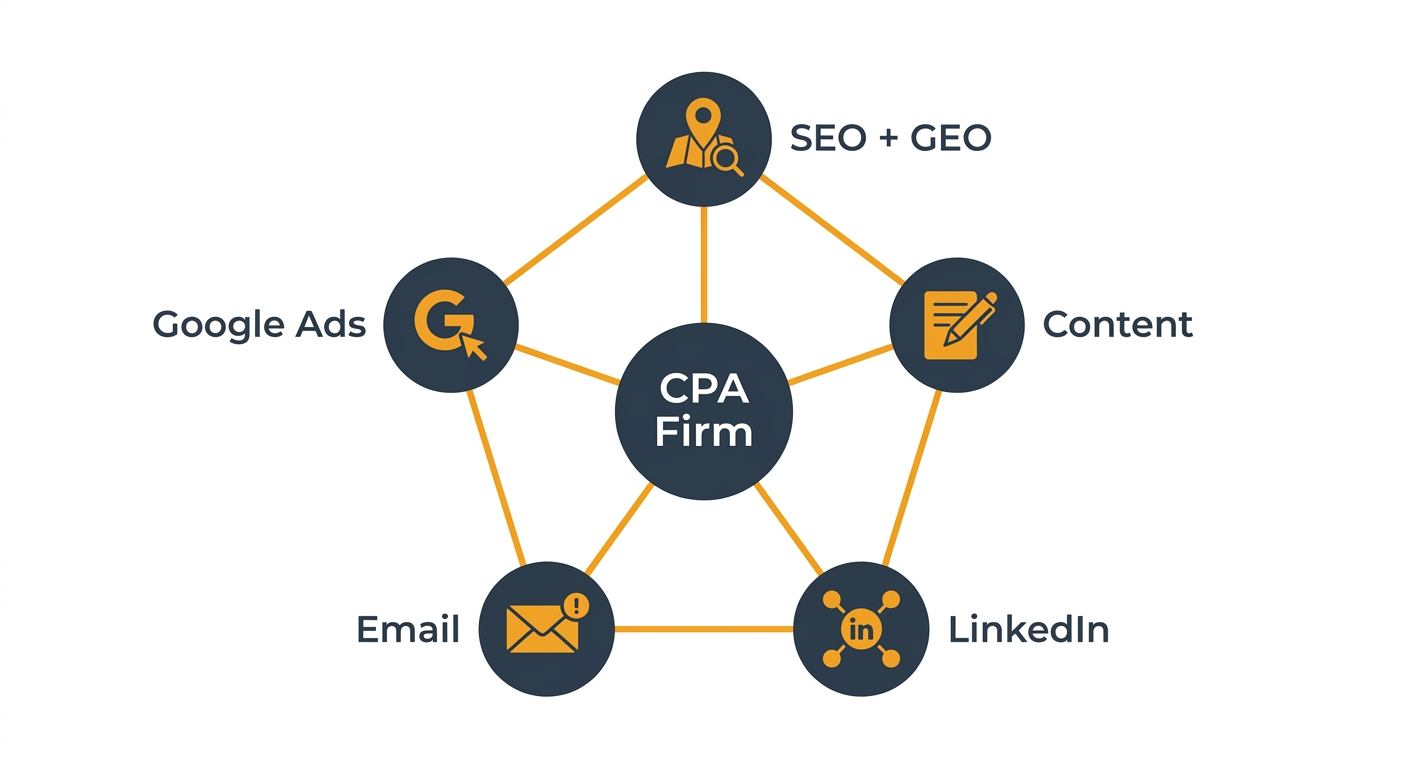
Digital marketing for accounting firms in 2026 looks different to what it looked like two or three years ago. AI search has changed how your future clients find services. The firms that are growing have built a visibility system — not just a website. And the ones still waiting for referrals to recover are watching the gap widen.
This guide covers what actually works, what to avoid, the right order to build it, and what realistic results look like. No generic advice. No tactics built for e-commerce or other industries. Just a clear picture of what a modern CPA firm marketing system looks like — and how to build one.
Why Most Accounting Firms Are Still Marketing Like It’s 2019
For most of the last decade, established CPA firms didn’t need to market. Referrals came in, word spread, and the firm grew naturally. Marketing was something you did if you needed it — not something you built as a system.
That era is over.
The small business owners and entrepreneurs who used to ask around for an accountant now search online. They Google “accounting firm for small business owners,” ask ChatGPT for recommendations, and check Google reviews before picking up the phone. The referral might still close the deal — but the first filter is digital.
Firms that haven’t built a digital presence are invisible at that first filter. They’re not losing clients to better accountants. They’re losing them to accountants who show up online.
The firms winning new business in 2026 have built what we call a visibility system: an integrated set of digital channels — SEO, content, social, ads, email — that ensures their firm gets found consistently by the right people at the right time. It’s not complicated. But it does need to be built in the right order, and it needs to be maintained.
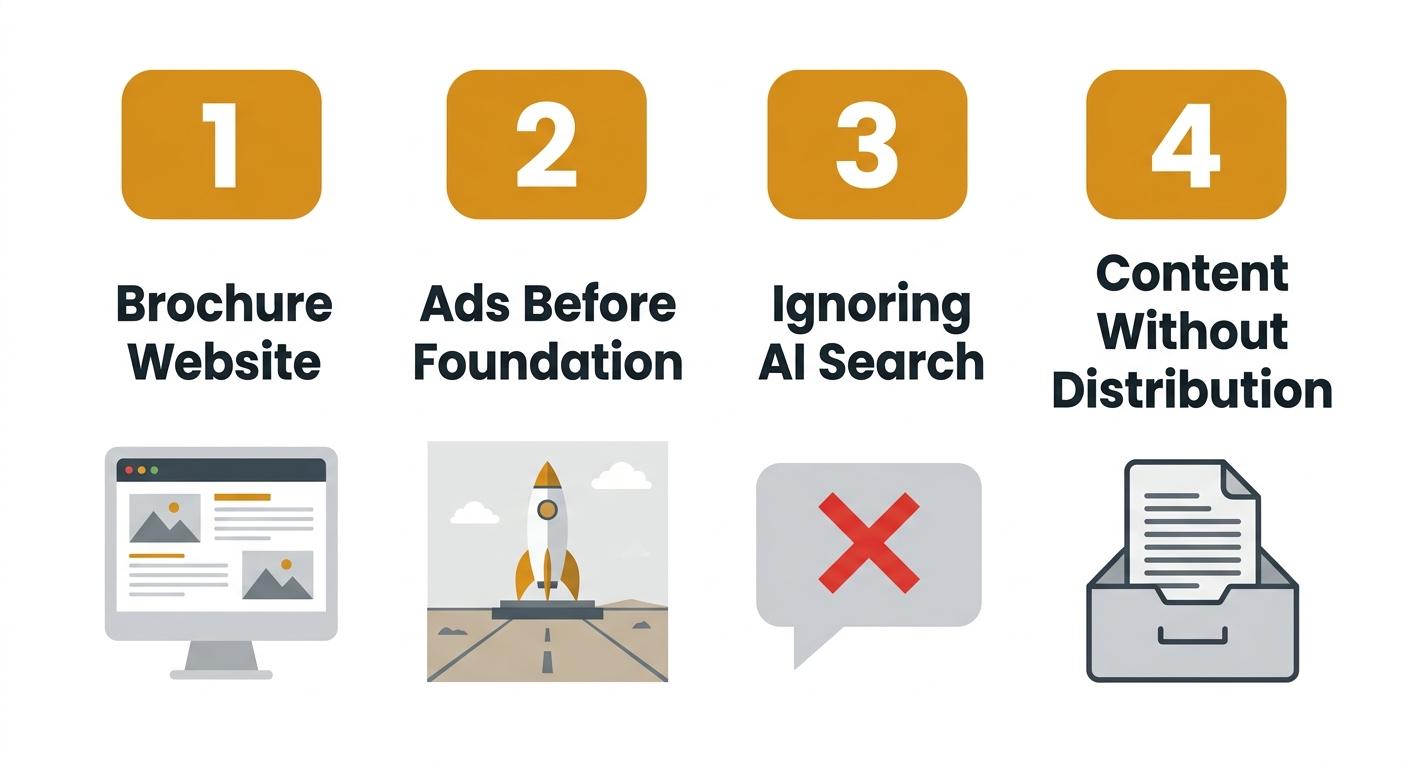
The 4 Biggest Digital Marketing Mistakes CPA Firms Make
Before we get into the channels, let’s talk about what most firms get wrong. These mistakes show up consistently across firms of every size.
Mistake 1 — Treating the Website as a Brochure
Most accounting websites look professional. They have a homepage, a services page, an about page, and a contact form. They also do nothing.
No SEO. No content. No clear reason for a visitor to stay, trust the firm, or book a call. Most accounting websites I look at don’t even have real images of the partners or the team. It looks like an AI accounting firm — and I wouldn’t trust my business or finances to that.
Your accounting website should be the engine of your entire marketing system. Every other channel — Google, LinkedIn, Instagram, email — drives traffic back to it. If the website doesn’t convert visitors into enquiries, every other channel is wasted effort.
Mistake 2 — Running Ads Before the Foundation Is Ready
Google Ads can generate qualified leads for an accounting firm. But only if the website they’re landing on is optimised to convert.
Ads amplify what’s already there. If your website (or a dedicated landing page) doesn’t clearly communicate your positioning, your service offering, and a compelling reason to get in touch — ads will burn budget and produce poor results. The build order matters.
Mistake 3 — Ignoring AI Search
In 2025, AI search went from a novelty to a primary discovery channel. In 2026, it’s foundational.
When a small business owner asks ChatGPT “what should I look for in an accountant for my e-commerce business?” or prompts Google for “best accounting firm for startups near me,” AI systems pull answers from structured, authoritative web content. Firms whose websites and blogs are structured correctly for AI extraction appear in those answers. Firms that aren’t don’t.
This is called Generative Engine Optimisation (GEO). It’s not a future consideration — it’s a current one. And it’s built into your content strategy from day one, not bolted on later.
Mistake 4 — Publishing Content Without a Distribution Plan
Writing one blog a month and hoping Google notices it six months later is not a content strategy. It’s a filing cabinet.
Content needs to be structured for search, consistent in cadence, and distributed across channels to generate any return. One well-written blog post can fuel a LinkedIn post, an Instagram infographic, a short video clip, an email to your list, and an AI-search citation — but only if you’ve got a system to make that happen. Without the system, content is effort without return.
The Modern Digital Marketing Stack for Accounting Firms in 2026
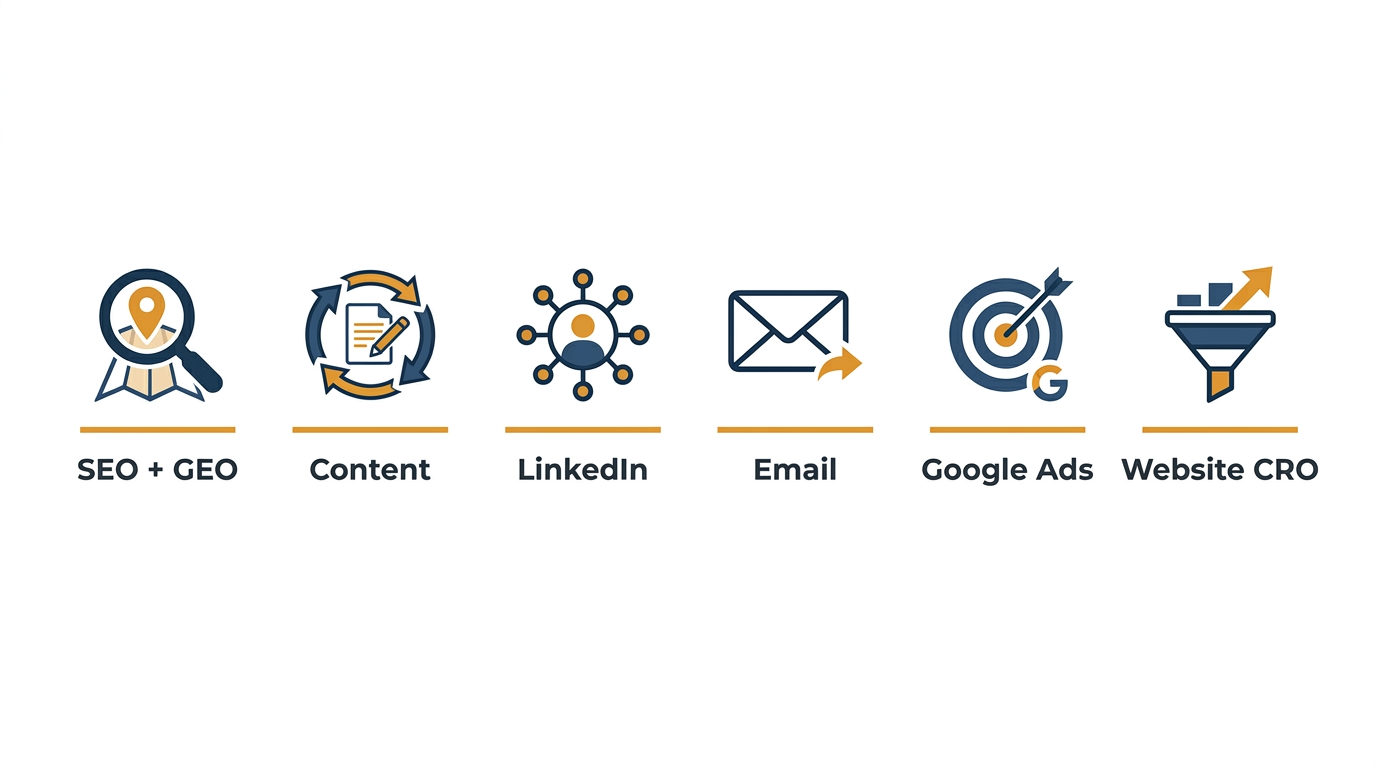
Here are the core channels that make up a complete digital marketing system for a CPA firm today. Not every firm needs all of them on day one — the right mix depends on where you’re starting from — but these are the building blocks.
SEO and GEO — Getting Found on Google and in AI Search
SEO remains the foundation. Service pages optimised for your target keywords, location targeting for the markets you serve, and a blog strategy built around topics your future clients are actively searching.
GEO is the 2026 layer on top. Generative Engine Optimisation is the practice of structuring your content so it gets cited by AI systems — ChatGPT, Perplexity, Google AI Overviews — when someone asks a relevant question. It involves clear definitions, FAQ sections, structured headings, and direct answers written into your content.
The good news: SEO and GEO are converging. Content written well for Google — clear, structured, authoritative, deep — is also the content that AI systems surface. You don’t build two separate strategies. You build one, correctly.
A small business owner searching “best accountant for a growing business” in Google and the same person asking ChatGPT the same question should both be finding your firm. That’s the goal.
Content Marketing — Building Authority and Staying Visible
Content is how your firm demonstrates expertise before a prospect ever contacts you. Blogs that answer the questions your future clients are searching. Video content that builds trust and familiarity. Social media that keeps your firm consistently visible as they scroll.
The social media component here is specifically about brand awareness — not direct lead generation. When the small business owners and entrepreneurs you want to reach see your firm’s content regularly on LinkedIn, Instagram, or Facebook, you stay top of mind. By the time they’re ready to look for an accountant, you’re already a familiar name.
One blog post, distributed well, can become a LinkedIn post, an Instagram graphic, a short video, and an email newsletter item. That’s the content repurposing engine — and it’s what separates firms that get value from content from those who find it exhausting.
LinkedIn — B2B Lead Generation
LinkedIn is the most direct channel for reaching the exact audience your firm serves: small business owners, founders, entrepreneurs, and professionals across every sector.
Consistent presence on LinkedIn — useful posts, direct outreach, growing your network in the right direction — positions you as a visible authority. When a connection’s accountant retires, or their current firm stops responding, or they’ve outgrown their bookkeeper and need proper advisory — your name is already there.
LinkedIn isn’t quick. But for B2B lead generation, it’s one of the highest-quality organic channels available to an accounting firm.
Email Marketing — Nurturing Leads Over Time
Most visitors who find your website won’t book a call on their first visit. They’re researching. They’ll leave, do more research, and eventually return when they’re ready.
Email captures that audience before they disappear.
A lead magnet — a free guide, a checklist, a useful resource — gives people a reason to share their email. In our agency, we’re moving away from lead magnet information that you can easily find on ChatGPT and adopting more dynamic lead magnets that engage visitors, things like tax calculators or a live business scorecard. From there, a nurture sequence stays in touch, builds trust, and brings them back when they’re ready to make a decision. It’s not glamorous, but it’s one of the highest-ROI channels in your stack once it’s set up.
Google Ads — Turning On Qualified Leads
When your website converts and your foundation is solid, Google Ads can generate qualified leads within weeks. It’s the fastest path to new enquiries for an accounting firm.
The targeting is highly specific — you’re reaching people who are actively searching for an accountant right now. Business owners searching “CPA firm for small business,” “accountant for property investors,” “tax advisor for e-commerce.” These are high-intent searches from exactly the kind of clients you want.
But ads amplify what’s already working. They’re not a substitute for a converting website and a credible online presence. When everything else is in place, they’re extremely effective.
Website Conversion Optimisation
Every channel drives traffic back to your website. If the website doesn’t convert visitors into enquiries, none of the other channels pay off.
Conversion optimisation means clear positioning (what you do, who you help, why you’re different), fast load times, strong trust signals (client outcomes, credentials, firm background), and one clear path to getting in touch. It’s not about design for its own sake — it’s about removing friction between a visitor who’s interested and a conversation that could lead to a new client. We live in a modern world of low attention spans and a desire for quick results. Visitors need to be able to quickly glean the information they need to make a decision and then easily take the action you’re looking for (ie — fill in a form).
The Right Order to Build Your Marketing
This is where most firms — and most generalist agencies — get it wrong. They start with ads because ads produce fast results, without setting up the foundation that makes ads work. Or they start publishing content without any SEO structure behind it.
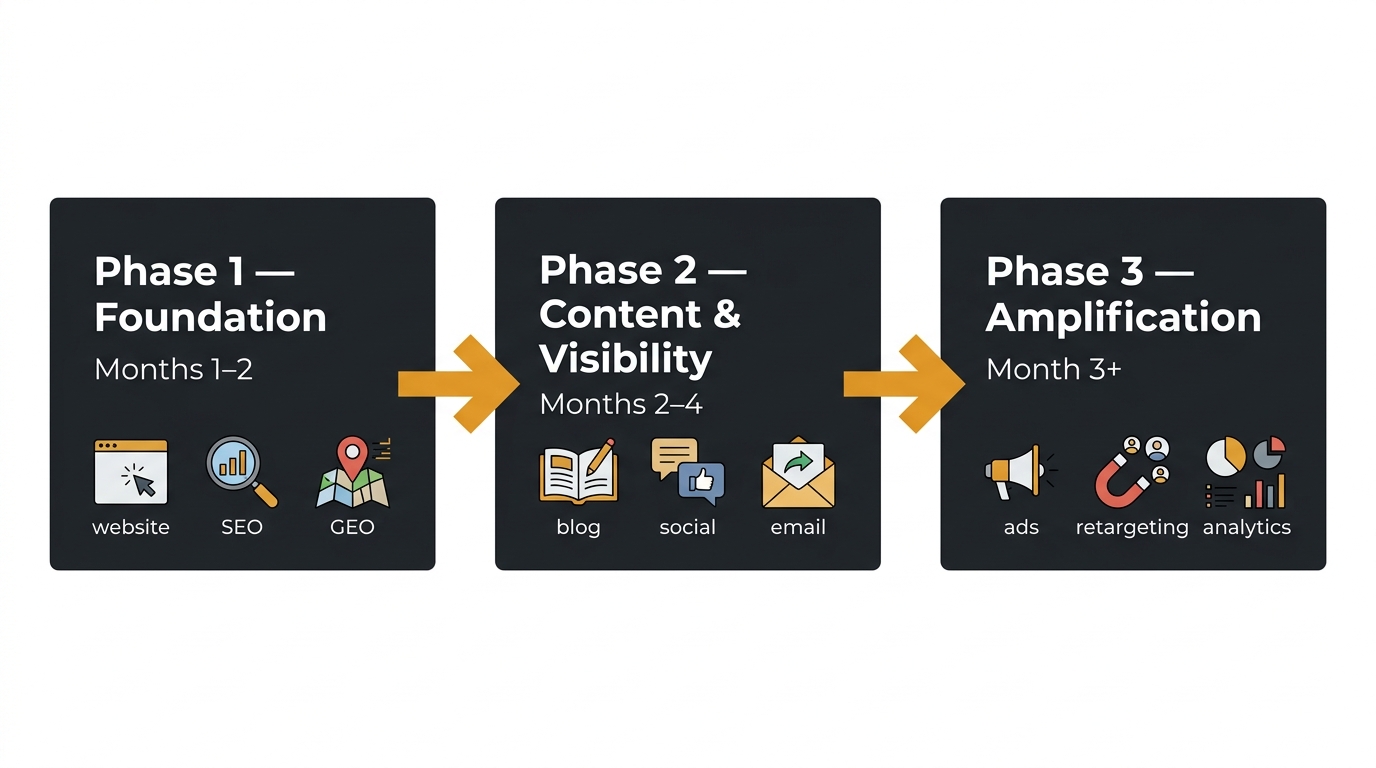
Order matters. Here’s how we build it.
Phase 1 — Foundation (Months 1–2)
Before anything else: get the fundamentals right.
- Website audit and optimisation — positioning, messaging, CTAs, page speed, trust signals
- SEO service page optimisation — keyword targeting, meta data, heading structure on core pages
- GEO structure built in from day one — FAQ sections, clear definitions, schema markup, structured content that AI systems can extract and cite
- Google Business Profile — set up, verified, and optimised for local and national visibility
The goal here is to make everything that follows more effective. Ads, content, social — they all land better when the website they’re driving traffic to is strong.
Phase 2 — Content and Visibility (Months 2–4)
With the foundation in place, start building authority and organic visibility.
- Blog content publishing — targeting keywords your future clients are searching, structured for both Google and AI search
- Social media presence — consistent brand visibility across the platforms where your clients spend time
- LinkedIn activity — growing the right audience, building authority through regular posts
- Email capture — lead magnet live, nurture sequence set up and running
Content compounds. The blogs you publish in Month 2 are still generating traffic 18 months later. The audience you build on LinkedIn now becomes leads in six months. This phase is about planting.
Phase 3 — Amplification (Month 3 Onwards)
Now you turn on the channels that accelerate what’s already working.
- Google Ads — website converts, foundation is solid, now ads make economic sense. Note, you could run ads sooner if you choose but, in this industry, the best practice would be to have a solid website and content strategy in place first.
- Retargeting campaigns — staying visible to people who’ve already visited
- Full content repurposing engine — one blog feeds LinkedIn, Instagram, video, and email automatically
- Monthly reporting — what’s generating leads, what’s being adjusted, where the next 90 days focus
Ready to build this for your firm? MITCO Digital builds and manages complete digital marketing systems for CPA firms across the US. Book a discovery call and we’ll walk you through exactly what this looks like for a firm at your stage.
DIY vs. Working With a Specialist Agency
If you’re handling marketing yourself, the most important thing you can do is focus. Pick two or three channels, build them properly, and don’t spread yourself across everything at once. A firm that’s excellent on LinkedIn and has a well-optimised website will outperform one trying to maintain six channels badly.
If you’re working with a specialist agency, the calculus changes. Full-channel coverage becomes achievable — not because the channels are different, but because quality is maintained at scale. A well-resourced agency with accounting-specific expertise can run your SEO, content, social, ads, and email simultaneously without any of them suffering.
The difference isn’t channel count. It’s execution quality.
What to look for in an agency:
- Accounting industry specialism — do they actually understand your clients, your services, and how CPA firms grow?
- Integrated strategy — are they selling you channels as standalone services, or building a system where everything works together?
- Transparent reporting — can you see what’s working and what it’s producing?
- No long lock-in before results — a good agency earns your confidence through performance, not contracts
Red flags: a generalist agency that markets everyone from restaurants to law firms, no accounting sector case studies, promises of instant results, or a pitch focused entirely on one channel (usually ads).
Realistic Timelines: When to Expect Results
One of the most common frustrations in marketing is expecting quick results from channels that compound slowly, or expecting paid channels to deliver without the infrastructure to support them. Here’s an honest timeline.
| Channel | When You Start Seeing Results |
|---|---|
| Google Ads | 2–4 weeks once live |
| SEO — initial improvements | 6–10 weeks (meta, structure fixes) |
| SEO — organic ranking growth | 3–6 months (compounding over time) |
| GEO / AI search visibility | 2–4 months with structured content |
| Content marketing | 4–8 months for meaningful organic traffic |
| Email marketing | First campaign: 2–3 weeks |
| LinkedIn organic | 6–12 weeks for consistent audience growth |
The firms that started this process 6 months ago are ahead. The ones that started 12 months ago are significantly ahead. The right time to start is now — and the right order is Phase 1 → Phase 2 → Phase 3.
Key Takeaways
- Digital marketing for accounting firms has changed significantly in 2026 — AI search is now a primary discovery channel, not a future consideration
- Most CPA firms make the same four mistakes: brochure website, ads before foundation, ignoring GEO, content without distribution
- The modern digital marketing stack includes SEO + GEO, content (blogs, video, social), LinkedIn, email, and Google Ads — in that build order
- If you’re doing it yourself: focus on 2–3 channels done well. With a specialist agency: full-channel coverage becomes achievable
- Marketing compounds. The firms winning new clients online started 6–12 months ago. Starting now is the answer.
FAQ
How much should an accounting firm spend on digital marketing?
There’s no fixed number, but a useful benchmark: 5% of target annual revenue. Firms spending $3,500–$6,000 per month on a fully integrated, holistic marketing system (SEO, content, ads, social, email) typically see meaningful results within 3–6 months. Spending less on a single channel often produces less than spending more on an integrated system. Budget should align with growth goals — if you want 3–5 new qualified clients per month, your marketing investment needs to match that ambition.
Does content marketing actually work for CPA firms?
Yes — but it takes time and consistency. A CPA firm that publishes two to four high-quality, keyword-targeted blogs per month, distributed properly, will see meaningful organic traffic growth within 4–6 months. The key is quality over quantity and structuring content for both Google and AI search. Thin, generic content doesn’t rank. Specific, well-structured, expertise-led content does.
How long before we start seeing new clients from digital marketing?
Paid channels (Google Ads) can produce enquiries within 2–4 weeks of going live — assuming the website converts. Organic channels take longer and depend on the base you’ve already built. SEO typically produces meaningful results in 6–12 months. A complete system running together produces compounding results: slow at first, significant at 6–8 months, substantial at 12–18.
Do we need to be on every social media platform?
No. The goal with social media for a CPA firm is consistent brand visibility among your target audience — small business owners, entrepreneurs, professionals. LinkedIn, Instagram, and Facebook cover the vast majority of that audience. You don’t need to be on every platform. You need to be consistent on the right ones.
What’s the difference between SEO and GEO — and do we need both?
SEO (Search Engine Optimisation) is optimising your website and content to rank in traditional Google search results. GEO (Generative Engine Optimisation) is structuring your content so it gets cited by AI systems like ChatGPT, Perplexity, and Google AI Overviews. In 2026, both matter — and fortunately, they’re largely complementary. Good SEO content, written with clear structure, direct answers, and FAQ sections, performs well in both environments. You don’t need two separate strategies. You need one built correctly from the start.
How do I know if an agency actually understands accounting firms?
Ask them: which CPA firms have they worked with, what results did those firms see, and can they give you a specific example of a marketing strategy they built for a firm like yours? A genuine specialist will have concrete answers. A generalist will give you vague references to “professional services clients.” The difference is obvious when you ask the right questions.
Ready to Build Your Firm’s Marketing System?
Most CPA firms stall at the same revenue ceiling for 3–4 years. It’s not because they’re bad at accounting — it’s because referrals stop scaling past a certain point and there’s no other acquisition channel to replace them.
MITCO Digital builds complete digital marketing systems exclusively for accounting firms. SEO, content, AI search visibility, Google Ads, social media, email — fully managed, fully integrated, reporting you can actually read.
If you’re ready to build a marketing system that generates consistent, qualified leads every month — book a discovery call. We’ll walk you through exactly what this looks like for a firm at your stage.