
Exclusive Guide · $500 Value · Now Free
The Accountants Guide to Rank in AI Search
- 10 Proven Strategie to Rank on ChatGPT & AI Platforms
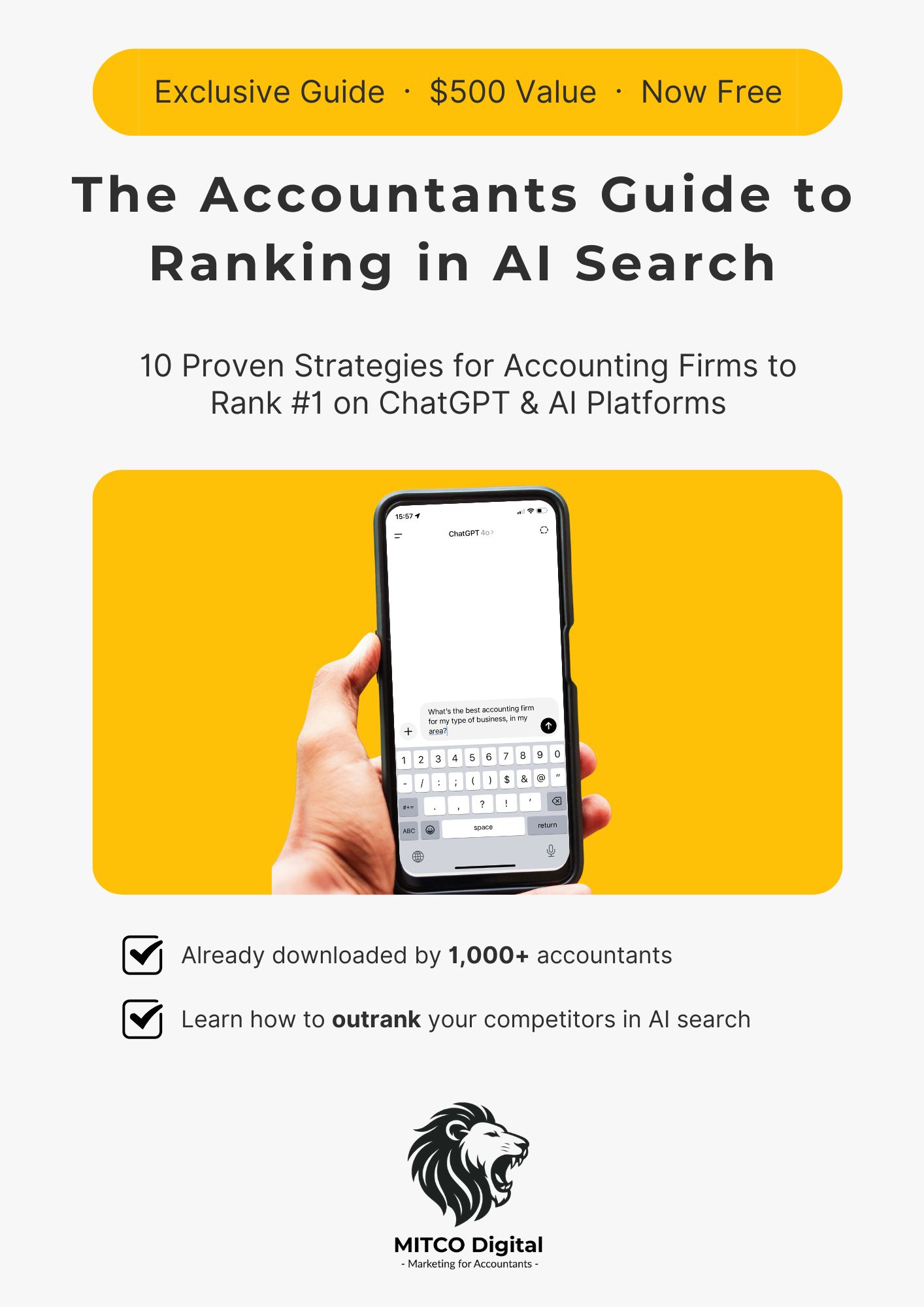

Want your accounting firm to show up in AI results?
Learn how to rank in ChatGPT by optimizing your content, authority, and site structure the right way.

Mike de Ravel is the CEO of MITCO Digital, a marketing agency that helps accounting firms grow through paid ads, SEO, and AI-driven strategy. With over 25 years in marketing and 8 years leading MITCO Digital, he specializes in helping accounting firms put a comprehensive, integrated marketing strategy in place.
Tired of reading?
Listen to our hosts, Minnie Profit & Max Refund, discuss this topic.
Try this – pull up ChatGPT on your device now and ask it: ‘Help me find a small business accountant in my area.’
Does your accounting firm rank in the results?
In 2025 and beyond, AI tools like ChatGPT are changing how business owners search for answers, and for your services. If you run an accounting firm and want to generate new clients through online channels, it’s critically important that you understand this shift in search behaviour and how to respond.
In this post we’ll cover:

Avoid wasting your time and money with strategies that don’t work.
We’re a results based, AI-focused, agency for accounting firms. You get a team that knows what works, from day 1!
Instead of Googling “business accountants near me” or “tax planning CPA,” more and more people are asking ChatGPT instead. And more importantly, they trust the answers they get. This also applies to other AI platforms too such as Alexa, Google Gemini, and Perplexity.
People are asking things like:
ChatGPT generates answers based on what it knows and what it’s been trained on. ChatGPT-4 searches the web in real time via Bing search.
If your website has clear, helpful content that answers these types of questions, there’s a good chance ChatGPT will reference your firm or pull insights from your website.

This shift presents a unique opportunity for accounting firms. If you know how to rank in ChatGPT responses, you’re not just winning visibility and clicks, you’re immediately earning trust. Trust is very hard to establish quickly online so this is a powerful benefit for firms showing up on these platforms.
But how do you actually go about ranking your website in ChatGPT’s answers in the first place?
In this guide, we’ll break down exactly how to rank in ChatGPT, and what steps accounting firms can take to become the trusted source ChatGPT recommends.
ChatGPT doesn’t always crawl the internet in real-time. Instead, it uses a mixture of:
This means your SEO strategy now needs to incorporate an AI focus. If your site is well-ranked on Bing (and Google), if your content is clear, structured, and helpful, and if other sites link to you or mention you, you have a much better chance of ranking in ChatGPT responses.
We’ve run our own tests. We noticed that firms that tend to have the above items in place not only rank well in map packs and on search engines like Google and Bing, but they also rank in ChatGPT.
As a leading marketing agency for accounting firms, we put a lot of emphasis on AI when crafting our clients’ marketing strategies. We’ve been able to successfully rank a number of our clients (as well as our own agency) on ChatGPT and generate qualified leads through this platform.
Let’s discuss a strategy for your firm.
ChatGPT loves structured, scannable content. Think:
For example, someone could ask ChatGPT a question like: ‘How can a tax accountant help me reduce my business taxes?’
The answer: A tax accountant can help you reduce your business taxes in smart, legal ways. Here’s how: (and then ChatGPT goes into a bullet list)
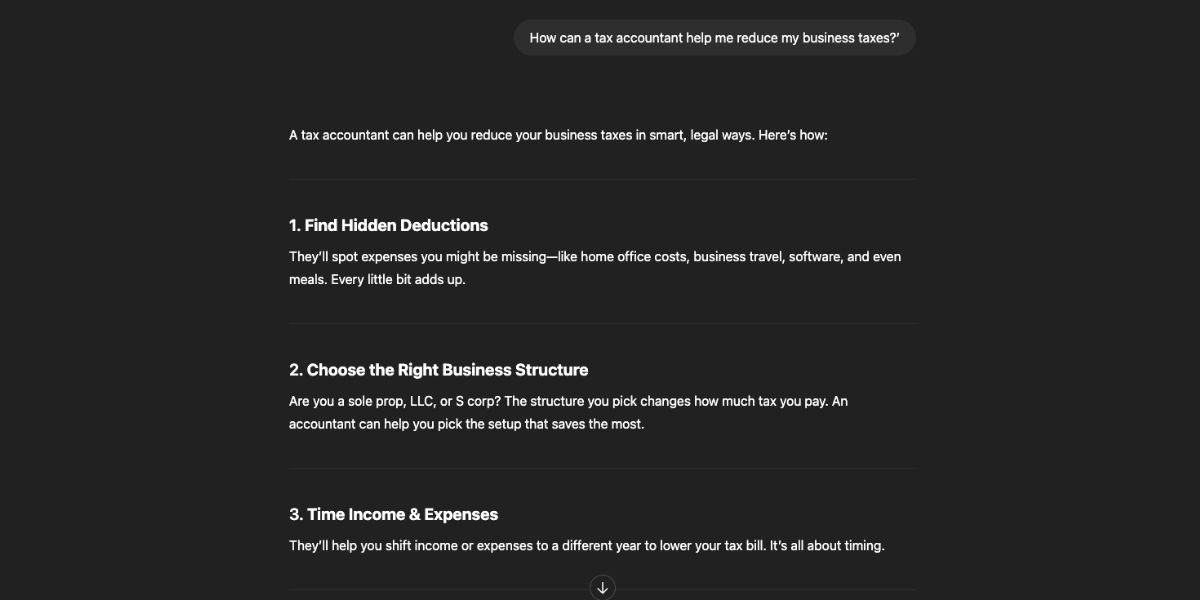
If you have this type of content clearly laid out on your website, you have a chance of showing up for this type of search and generating a lead – someone who’s looking for tax planning services.
This type of content is also more likely to appear in featured snippets on Bing and Google, and more likely to be used by ChatGPT.
High-volume keywords are great, but today’s search results and AI generated responses tend to favor long-tail search terms over short keywords. That’s how people actually search now, especially when doing so with voice search.
For example, two years ago someone might have typed into Google ‘small business accountant.’ Now they speak to ChatGPT using the voice prompt and have a conversion, something like,
‘I’m looking for a business accountant in my area that works with restaurants, understands the financial challenges of a restaurant and can help me cut costs and scale operations. Can you help?’
ChatGPT favors content that directly answers that user’s intent. That means targeting you need to target long-tail, specific search phrases.
Instead of just “bookkeeping services,” try:
Creating content that clearly answers those questions makes it easier for AI platforms to reference your site and for your firm to rank in ChatGPT.

Authority matters. Why should your site rank in ChatGPT ahead of another firm? A lot of that comes down to authority. How well can your website, you, and your firm be trusted online?
Most accounting firms that haven’t been doing any SEO will have a domain authority score well below 10 out of 100. There’s a lot of work required to build this authority up and you have to keep in mind that it will take time. But it will be worth it. Speak to us if you need a domain authority audit.
One way you can improve your authority is to create content that is highly useful, accurate, and trustworthy. That way it’s more likely it is to be referenced.
To build authority:
For example: Instead of a general “What is a balance sheet?” article, write a detailed guide on “How to Use Your Balance Sheet to Prepare for a Business Loan.” Include real insights and examples from your own experience.

ChatGPT tends to trust what the broader internet trusts. One way of reflecting that trust is through what’s known as backlinks. These are links from other websites and online sources back to yours. Focus on quality over quantity. There’s no point having 1,000 backlinks from dodgy sites in countries you don’t serve. Rather focus on 10 high quality links from highly authoritative websites (like accounting associations, industry publications, Youtube channels, podcast, etc).
Some ways to build links:
Building a backlink strategy isn’t just good for SEO, it improves your firm’s visibility across the platforms ChatGPT learns from.
When ChatGPT does search online, it uses Bing. You need to make sure Bing knows your content exists.
Here’s a few basic things you can do to rank in ChatGPT:

Forward-thinking firms can now create a custom GPT trained on their content or embed a GPT-powered tool on their website.
This doesn’t influence how ChatGPT responds to public users (yet), but it’s a smart way to:
Tools like OpenAI’s GPTs and custom chat widgets make it easy to integrate this into your site.
One of our clients, a tax advisory firm in Texas, came to us with a simple goal: attract more quality leads.
One of the questions we immediately asked ourselves was ‘How can we rank them on ChatGPT?’ This is a platform where high net worth individuals and business owners often discuss strategic issues, like tax planning, with AI.
Amongst other things, we built out:
Eight months later, they were ranking for high value search terms, not just on Google and Bing, but also on ChatGPT. And, more importantly, they started generating quality inquiries through ChatGPT.
The future of search is conversational. And that means the best content isn’t just keyword-rich, it’s genuinely helpful.
If you want your firm to rank in ChatGPT, the strategy is clear:
If you need a partner to help make that happen, whether through content, SEO, or digital strategy, speak to an agency that has a proven track record and knows how to rank in ChatGPT.
MITCO Digital has successfully ranked numerous accounting firms on ChatGPT.
If you’d like to discuss our services and strategy for your firm, complete the form and we’ll get back to you shortly.
AI tools like ChatGPT are fundamentally shifting search behavior. Instead of traditional keyword searches on Google, users are increasingly having conversational interactions with AI platforms, asking complex questions like, “Who are the best accounting firms for e-commerce?” or “What tax deductions can small businesses claim in 2025?” If an accounting firm’s content is clear, helpful, and structured to answer these types of questions, it has a significant opportunity to be referenced by ChatGPT, which immediately builds trust with potential clients.
ChatGPT doesn’t always crawl the internet in real-time. Instead, it relies on a combination of factors: patterns identified in its vast training data (pre-2023 information including websites, books, and articles), real-time search engine data primarily from Bing, the presence of structured and well-formatted content, the authority score of a domain, and how frequently information is referenced across the web. This means that an effective AI SEO strategy requires a strong presence on Bing and Google, clear and helpful content, and a robust backlink profile.
To rank in ChatGPT, accounting firms should focus on creating structured, scannable content. This involves using clear headings (H2s) that ask and answer specific questions, incorporating bullet points and numbered lists, and providing concise definitions and summaries. This format makes content easier for AI to process and is also more likely to appear in featured snippets on traditional search engines like Bing and Google.
Traditional high-volume, short keywords are less effective in the conversational AI era. People now use more specific, longer phrases, often in the form of questions or conversational prompts (e.g., “I’m looking for a business accountant in my area that works with restaurants…”). ChatGPT favors content that directly answers this specific user intent. Therefore, firms should target long-tail keywords like “monthly bookkeeping services for restaurants in San Diego” instead of just “bookkeeping services” to increase their chances of being referenced.
Authority is extremely important. ChatGPT, like traditional search engines, trusts websites that the broader internet trusts. This is reflected in a domain’s authority score. To build authority, firms should publish in-depth, accurate, and trustworthy content, referencing real data, sources, and case studies, and including original insights. Regularly updating content also contributes to building this credibility over time.
Backlinks, which are links from other reputable websites to an accounting firm’s site, are a key indicator of trust for ChatGPT. The focus should be on quality over quantity – a few high-quality links from authoritative sources (like accounting associations, industry publications, or podcasts) are more valuable than many low-quality ones. Building a strong backlink profile not only improves SEO but also enhances the firm’s visibility across the platforms ChatGPT learns from.
Bing indexing is critical because ChatGPT-4 searches the web in real-time primarily using Bing. Therefore, an accounting firm must ensure their content is properly indexed by Bing. This involves submitting sitemaps to Bing Webmaster Tools, monitoring and fixing crawl errors, improving site speed and mobile-friendliness, using clean URLs and proper metadata, and ensuring that robots.txt files aren’t blocking important pages from being indexed.
Yes, forward-thinking firms can create custom GPTs trained on their own content or embed GPT-powered tools directly onto their websites. While this may not directly influence how ChatGPT responds to public users yet, it’s a smart way to provide instant answers to website visitors, create content that naturally aligns with GPT-style interactions, and future-proof their overall marketing strategy in an increasingly AI-driven landscape.