
Exclusive Guide · $500 Value · Now Free
The Accountants Guide to Rank in AI Search
- 10 Proven Strategie to Rank on ChatGPT & AI Platforms



Mike is the Founder at MITCO Digital - a full service digital marketing agency exclusively for accountants, CPAs, tax pros and bookkeepers, since 2018.
It’s a story we hear all the time. A firm builds a solid reputation, grows steadily on referrals, and hits that $1.5M or $2M revenue mark.
Then… silence. The growth curve flattens out.
If this sounds familiar, you’ve probably hit the accounting firm growth plateau. It’s a predictable—and frustrating—stage where the passive referrals that fueled your early success are no longer enough to keep the engine running.
Prefer to listen to this instead? Join our hosts, Minnie Profit & Max Refund, as they discuss this topic.
For years, your firm’s growth felt almost automatic, right? Happy clients told their friends, and your practice expanded without much of a formal marketing plan. But now, that once-reliable engine seems to be sputtering. The referral pipeline is less predictable, and bringing in new clients feels more like a struggle than a sure thing.
This isn’t just a slow month; it’s a systemic problem.
The strategies that got you to your first million in revenue are rarely the same ones that will get you to $5 million and beyond. The market has shifted. What used to be a steady stream of word-of-mouth leads has dried up, creating a “referral ceiling”—a hard limit on your growth.
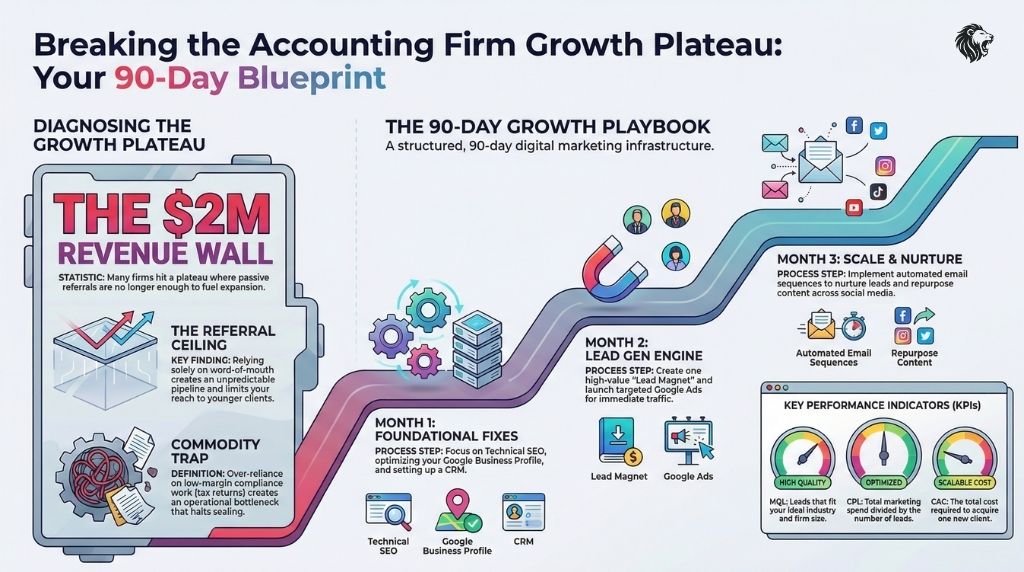
So, how do you tell the difference between a temporary dip and a genuine plateau? The symptoms are often hiding in plain sight, showing up across your client list, your team, and your online presence.
Here are the warning signs we see every day with firms that come to us for help:
A Stagnant Client List: Your net new client count is flat or even shrinking. For every new client you onboard, you seem to lose one, keeping your revenue stuck in the same place.
Losing Talent to Modern Firms: You’re struggling to attract and retain top accounting professionals. Let’s be honest, the best people are drawn to firms with a visible, modern brand and a clear path for growth.
Online Invisibility: You realize your firm is a ghost to the next generation of business owners. These clients don’t ask their buddies for a referral; their first move is to search online for “CPA for [my industry]”—and your firm is nowhere to be found.
A growth plateau isn’t a reflection of your accounting expertise. It’s a sign that your firm has outgrown its original client acquisition model and now requires a more deliberate, proactive digital strategy to reach the next level.
This shift can be unsettling. You’re an expert at accounting, not digital marketing. The thought of navigating SEO, Google Ads, and content creation feels overwhelming, especially when you’re already swamped with client work. But ignoring these signs is no longer an option if you want to build a valuable, scalable practice.
It’s crucial to diagnose the problem correctly. Is this just a quiet quarter, or is it a sign of something more fundamental? This quick comparison can help you spot the difference between a temporary slowdown and a true plateau.
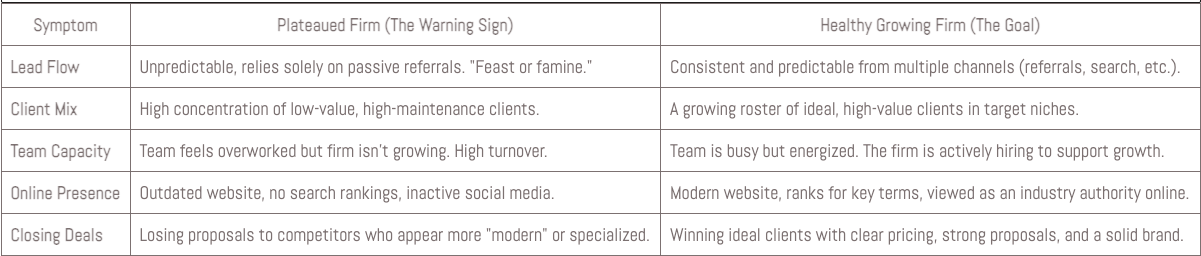
If your firm’s reality looks more like the “Warning Sign” column, you’re not just in a slump—you’re on a plateau.
The good news? This is a completely solvable problem. It simply means it’s time to evolve from a practice built on hoping for the phone to ring to a business driven by a strategic, proactive client acquisition engine. This new playbook isn’t about abandoning what worked; it’s about building on it with a system designed for predictable, scalable growth.
So, you’ve hit a wall. Revenue has flatlined, new client inquiries have dried up, and you feel like you’re running on a treadmill just to stay in the same place. It’s a frustrating spot to be in, and one we see a lot.
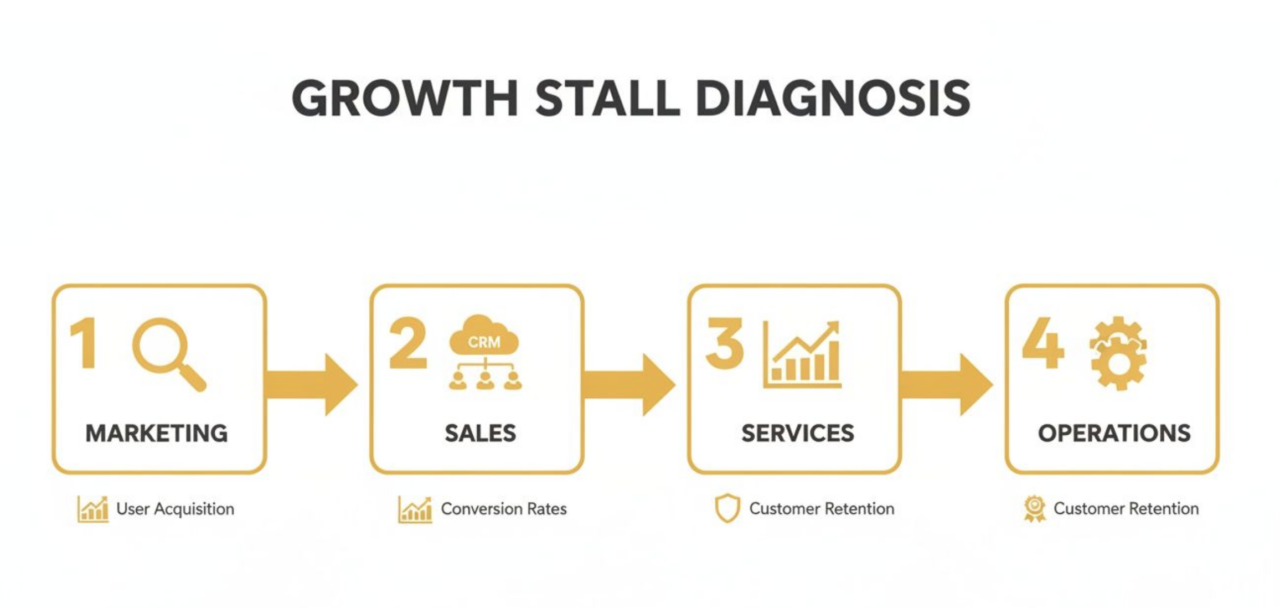
Before you can fire up the growth engine again, you need to get brutally honest about what’s holding you back. An accounting firm’s growth plateau is rarely a single problem. It’s almost always a tangled mess of issues across four key areas: Marketing, Sales, Services, and Operations.
Most partners we talk to already feel this in their gut. They know something’s off, but it’s tough to see the forest for the trees when you’re buried in client work. Let’s pull back the curtain and diagnose the specific weak spots that are putting the brakes on your growth.
When growth stalls, the first place to look is your marketing and sales—or, more often than not, the complete lack of it. For firms that grew purely on referrals, this is usually the most underdeveloped part of the business. You might have a stellar reputation, but if potential clients can’t find you online, you’re invisible to a massive chunk of the market.
Here are a few common symptoms we see all the time:
An Outdated Website: Your site looks like it was designed back in 2015. It isn’t mobile-friendly and talks all about you instead of focusing on your clients’ problems. It’s a digital brochure, not a machine for generating leads.
A Ghost Town on Google: A local business owner searches for an accountant in their industry. Your competitors pop up on the first page, but your firm is nowhere to be seen. You have zero visibility for the high-intent searches that actually bring in new business.
Leads Falling Through the Cracks: A prospect fills out your contact form, but it takes two days for anyone to get back to them because the notification just lands in a generic inbox. Without a formal Customer Relationship Management (CRM) system, good leads are lost every single day.
A growth plateau often kicks in when a firm’s digital presence doesn’t live up to its real-world expertise. You might be the best firm in town, but if your website and online brand look neglected, you lose all credibility before a prospect even thinks about calling you.
these issues are like a leaky bucket. Even if you manage to get a few online inquiries, a clunky website and a painfully slow follow-up process mean most of those opportunities are gone before they ever have a chance to become qualified leads
Next, let’s audit your services. Many firms hit a revenue ceiling not because they don’t have enough clients, but because the work they’re doing has a natural limit on its value and scalability. A practice built entirely on compliance is the classic example.
There are only so many hours in the day for tax returns and bookkeeping. It’s essential work, sure, but it’s often priced like a commodity, which means high-pressure deadlines and razor-thin margins. You end up on a hamster wheel, constantly needing to sign more and more low-margin clients just to see a tiny bump in revenue.
This is a direct cause of an accounting firm growth plateau. You’re busy, your team is completely overworked, but the firm’s top line just won’t budge.
The firms that break through this barrier do something different: they shift their focus to high-value advisory services. We’re talking about strategic tax planning, outsourced CFO services, and real business consulting. These services are priced on the value they create, not the hours they take, which opens up more scalable and profitable revenue. Moving from 100% compliance to a healthy mix of advisory is one of the most powerful moves you can make to reignite growth.
Finally, we have to talk about the elephant in the room: the accounting talent shortage. You can have the best marketing in the world bringing in dozens of leads, but if you don’t have the people to actually do the work, your growth is dead in the water.
By 2026, the US accounting sector is projected to face its steepest labor shortage ever. This talent drought is the quiet killer behind the growth plateaus we see in many mid-size firms. You can check out more on this by exploring the latest research on 99firms.com.
When no one “owns” marketing and hot leads are slipping through a broken (or non-existent) CRM, the problem gets ten times worse when you can’t hire the staff to handle more work anyway.
This operational logjam is often the final lock on a growth plateau. Partners start shying away from new business because they know their team is already stretched to the breaking point. It becomes a self-fulfilling prophecy where the firm stays stagnant simply because it isn’t built to handle the very growth it wants.
Knowing your firm is stuck is one thing; knowing how to get unstuck is something else entirely. After figuring out why you’ve hit a growth plateau, you need a clear, actionable plan. The problem is, most marketing “advice” is just an overwhelming, scattered list of tactics with no sense of priority.
You don’t need to do everything at once. Honestly, trying to is a fast track to burnout and wasted money. The real key is to focus on a sequence of high-impact activities that build on each other and create momentum.
This 90-day playbook is designed for busy accounting firms just like yours. We’ve broken it down into three focused 30-day sprints, starting with the foundational fixes that deliver the biggest impact.
We typically audit four core areas to figure out what’s causing a growth stall. This is what that process looks like.
As you can see, a plateau is rarely just a marketing problem. It’s usually a systemic issue that needs a coordinated plan across the entire business.
The goal for your first 30 days is simple: stop the bleeding and build a solid foundation. We’re not launching some massive, expensive campaign just yet. Instead, we’re fixing the leaks that are costing you opportunities right now and setting the stage for real growth.
Here are your priorities this month:
Technical SEO Audit: Before you can even think about ranking on Google, you need to make sure your website is technically sound. An audit will quickly uncover problems like slow page speed, broken links, or missing title tags that are quietly sabotaging your visibility. Fixing these is often the fastest way to get a quick boost in search rankings.
Google Business Profile (GBP) Optimization: For most accounting firms, your GBP is your single most important online asset for attracting local clients. A shocking number of firms have unclaimed or incomplete profiles. We focus on fully optimizing it: adding all your services, uploading high-quality photos, actively encouraging client reviews, and ensuring your name, address, and phone number (NAP) are consistent everywhere online. This is a low-effort, high-impact task that can start generating calls in a matter of weeks.
Basic CRM Setup: How many leads have you lost because they got buried in an email inbox? A simple Customer Relationship Management (CRM) system puts a stop to that. Setting up a tool like our own CRM for accountants (from $35/m) lets you track every single inquiry, automate follow-up reminders, and ensure no prospect ever falls through the cracks again.
The first month isn’t about generating a flood of new leads. It’s about building the infrastructure to handle the leads you’re already getting and preparing your online presence to be found by more people.
With your foundation solid, Month 2 is all about proactively generating new, qualified leads. We’re not trying to boil the ocean here. We’re focusing on creating one high-quality campaign and using a little bit of ad spend to get immediate traffic.
Your priorities for this month look like this:
Create One High-Value Content Asset: Forget trying to write weekly blog posts for now. Instead, pour your energy into creating one substantial piece of content—what we call a “lead magnet”—that solves a major pain point for your ideal client. Think a “Comprehensive Tax Planning Guide for Real Estate Investors” or an “S-Corp Election Checklist for Consultants.” This immediately positions you as an expert and gives prospects a real reason to hand over their contact info. For more ideas, check out our complete accounting marketing checklist.
Launch a Targeted Google Ads Campaign: SEO takes time, but Google Ads can drive qualified traffic overnight. We’ll create a small, highly targeted campaign sending searchers directly to a landing page where they can download your new content asset. The goal isn’t thousands of clicks; it’s getting a handful of highly qualified leads from people actively searching for the solutions you provide.
In the final 30 days, we take the assets we’ve built and start scaling our efforts. You now have a lead magnet that works and a small stream of new contacts coming in. The focus shifts from pure lead generation to nurturing those relationships and building your long-term authority.
Here’s what to focus on:
Set Up Email Nurture Automation: When someone downloads your guide, what happens next? A simple automated email sequence can welcome them, offer more helpful tips, and gently guide them toward booking a consultation. This builds trust and keeps your firm top-of-mind without any manual effort from you or your team.
Repurpose Your Core Content: That big guide you created in Month 2 is a goldmine. Now, we slice and dice it. A section can become a blog post. A key statistic can become a social media update. The checklist can be shared on LinkedIn. This approach maximizes the value of your initial effort and starts building out your long-term SEO footprint.
This 90-day plan isn’t about doing everything—it’s about doing the right things in the right order. It’s a proven way to break through that frustrating growth plateau and build sustainable momentum for your firm.
Alright, let’s get specific about what actually moves the needle. Effective marketing isn’t about chasing every shiny new trend or posting randomly on social media. To break an accounting firm growth plateau, you have to master the platforms where your ideal clients are actively looking for help right now.
For most firms, this means channeling your energy into three core pillars that consistently deliver qualified, inbound leads. This isn’t theory—it’s a system we’ve seen work time and time again.
Today’s referral isn’t a phone call from a friend; it’s a Google search. When a local business owner needs a solution, their first move is typing in phrases like “CPA for real estate investors near me” or “accountant for small business.” If you don’t show up on that first page, you’re invisible.
This is where Search Engine Optimization (SEO) and your Google Business Profile (GBP) become your best friends. SEO is the long game of making your website more attractive to search engines, while your GBP is that critical map listing that shows up for local searches.
A well-optimized Google Business Profile is arguably the most powerful lead-gen tool for a local accounting firm. It’s your digital storefront. Neglecting it is like boarding up the windows of your physical office.
Getting local search right is more than just stuffing keywords onto a page. It involves:
Claiming and fully optimizing your GBP: This means adding your specific services, hours, real photos, and—most importantly—actively collecting client reviews.
Building local citations: You need to make sure your firm’s name, address, and phone number (NAP) are consistent across all the relevant online directories.
On-page SEO: Create dedicated service pages on your website that target the specific problems your local niche clients face.
Your website has one job: to turn visitors into leads. But honestly, most accounting firm websites are little more than digital brochures. They drone on about the firm’s history, list generic services, and completely fail to speak to the visitor’s actual pain points.
A high-converting website does the exact opposite. It works like your best salesperson, 24/7, engaging prospects and nudging them toward taking action. Shifting from a brochure to a conversion machine requires a few key changes.
Client-Focused Messaging: Stop talking about “our firm” and start talking about “your challenges.” The instant someone lands on your homepage, it should scream, “Yes, you’re in the right place.”
Clear Calls-to-Action (CTAs): Every single page needs a clear next step. “Schedule a Consultation,” “Download Our Tax Guide,” or “Contact Us Today”—you have to tell people what to do next. Don’t make them think.
Social Proof: Plaster your site with client testimonials, case studies, and logos of businesses you’ve helped. This builds instant trust and shows you’ve done this before.
Finally, the best way to attract high-value clients is to prove you’re an expert before they ever pick up the phone. You do this with strategic content. I’m not talking about generic blog posts like “5 Tips for Tax Season.” I mean creating deep-dive resources that answer your ideal client’s most urgent and specific financial questions.
To truly scale your marketing and bring in the right kind of leads, you might want to partner with a specialized SEO agency for accountants. They get the unique challenges of your industry. By creating content like a detailed guide on R&D tax credits for tech startups or a webinar on cash flow management for construction companies, you stop being just another accountant. You become the go-to authority in your niche.

Avoid wasting your time and money with strategies that don’t work.
We work exclusively with accounting firms. That means you get a team that knows what works, from day 1!
How do you actually know if your marketing is working? This is the question that keeps managing partners up at night. It’s a very real fear: sinking thousands of dollars into a generalist agency that just hands over vague reports filled with fuzzy “vanity metrics.”
Let’s be blunt. “Increasing brand awareness” doesn’t pay salaries. To break through a growth plateau, you have to stop treating marketing like a mysterious cost center and start treating it like a predictable, measurable investment. That shift begins by tracking the few key performance indicators (KPIs) that truly impact your firm’s bottom line.
It’s incredibly easy to get distracted by numbers that look good on paper but don’t translate to actual business. Website traffic is the classic example. Sure, a jump in visitors feels good, but if none of those people are qualified prospects, it’s just noise.
Instead, the firms we see succeeding focus on a handful of KPIs that directly measure the health of their client acquisition engine.
Marketing Qualified Leads (MQLs): This isn’t just a name in a contact form. An MQL is a lead that fits your ideal client profile—they’re in the right industry, the right size, and have a problem you can actually solve. Tracking this number tells you if your marketing is attracting the right people.
Cost Per Lead (CPL): A simple but powerful calculation: Total Marketing Spend / Total Number of Leads. It puts a hard dollar amount on what it costs to get a potential client to raise their hand. Knowing your CPL helps you budget effectively and see which channels are most efficient.
Client Acquisition Cost (CAC): This is the big one. It answers the ultimate question: “How much did we spend to land this new client?” You calculate it by dividing your total marketing and sales costs over a period by the number of new clients you won in that same period.
Your CAC is the truth-teller of your marketing efforts. When you know it costs, for example, $3,000 in marketing to acquire a new client that will pay you $15,000 annually, marketing suddenly stops feeling like an expense and starts looking like a growth investment.
Tying your marketing spend directly to new revenue is the final piece of the puzzle. This is where a good CRM becomes absolutely essential. It allows you to track a lead from their very first touchpoint—like a Google Ad click or a blog post they read—all the way through to a signed engagement letter.
A CRM makes it easy to see which marketing channels are delivering the most valuable clients. If you’re weighing your options, you can explore our guide on the best CRMs for CPA firms.
The fix for a growth plateau isn’t more guesswork. We’ve found that well-executed, niche digital strategies can consistently yield 3-7 qualified inbound leads every single month within 90 days. That provides the predictable pipeline you need to break a plateau without having to hire more internal staff.
To really dial this in, you have to measure marketing attribution and prove ROI. This is what gives you the confidence to double down on what’s working and cut what isn’t. By adopting this ROI-centric approach, you’re not just “doing marketing”—you’re building a scalable, predictable system for growth.
We talk with accounting firm partners every single day. When they’re feeling stuck and ready to finally break through that growth ceiling, the same handful of questions always seem to come up.
Let’s tackle them head-on.
This is the classic, and it’s a completely fair question. For years, maybe decades, referrals were more than enough to keep you busy.
The problem is, relying only on referrals is exactly what creates the “referral ceiling” that leads to a plateau. A referral pipeline is great, but it’s unpredictable. You can’t scale it on demand. And it often starts to dry up as your best clients’ own businesses mature or they head toward retirement.
Digital marketing isn’t about ditching referrals. It’s about building a predictable, scalable client acquisition machine that puts you back in the driver’s seat. It gets your firm in front of the thousands of younger business owners who don’t ask a friend for a referral—their first move is always Google.
The goal is to shift from a business that hopes for growth to one that engineers it. By adding a digital marketing engine, you build a second, parallel pipeline that runs alongside your referrals. That’s how you build a more resilient, stable, and valuable firm.
I hear you. This is probably the most common (and completely valid) concern we come across. Almost every firm we talk to has a horror story about being burned by a generalist marketing agency that just didn’t get it.
They write generic blog posts, run ad campaigns that fall flat, and hand you fluffy reports because they don’t understand the difference between tax planning and tax prep. They don’t know your clients, your services, or the nuances of compliance.
Our entire world is accounting firms. We’re not a jack-of-all-trades agency trying to learn your industry on your dime. We know your clients’ biggest pain points inside and out, and we have a playbook that is proven to work specifically for this industry.
We skip the expensive guesswork and get right to implementing strategies we already know will generate qualified inbound leads for firms just like yours. That niche expertise is the difference between burning through your budget and investing in a system that produces a clear, measurable ROI.
We get it. You and your team are already underwater. You can’t suddenly take on a second job as a marketing department.
That’s why our entire process is designed as a “done-for-you” service. We intentionally built it to require minimal time from you.
Here’s what it typically looks like:
We have an initial strategy session where we go deep on your firm, your ideal clients, and your real revenue goals.
Our team of writers, SEO pros, and ad managers gets to work and handles all the execution.
You and your team are only involved at key checkpoints to review and approve the content and strategies we develop.
We do the keyword research. We write the client-facing articles. We optimize your online profiles and manage the ad campaigns. Your job is high-level approval, not getting bogged down in the daily grind. We handle the marketing so you can focus on what you do best: serving the new clients we bring in the door.
Not necessarily, and this is a classic trap. An outdated website definitely hurts your credibility and can be a big symptom of a growth plateau, but it’s not always the most urgent fix.
We see so many firms make the mistake of dropping $15,000–$25,000 on a beautiful new website that gets zero traffic. It just becomes a very expensive, very lonely digital business card.
Our 90-day playbook prioritizes the activities that actually drive traffic and leads first. This often means starting with foundational SEO and getting aggressive with your Google Business Profile. These are the strategies that can make your phone ring, even with an older, less-than-perfect website.
Once we’ve got a steady stream of traffic coming your way, then we can strategically tackle a website redesign as part of the bigger plan. This approach ensures your new site is built from the ground up using real data about what your audience actually wants. It becomes a powerful tool for converting all that new traffic into paying clients, not just a pretty brochure.

Ready to move beyond the plateau and build a predictable engine for new clients?
We’ve helped hundreds of firms do just that.
Book a discovery call with us today, and let’s start building your 90-day plan to reignite your firm’s growth.